


Permaculture Farming – For The Future
Ever wondered what happened to the BBC's 'A Farm For The Future' film makers, Rebecca Hosking and Tim Green? Well, they are testing out their research into permaculture on a farm scale. Permaculture magazine has persuaded them to keep us all regularly posted on their findings.
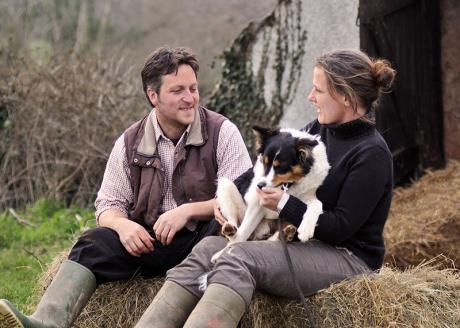
To call this just another blog about sustainable living and ecological food production would be essentially correct. What makes this slightly different is that we have 160 acres, a crumbling infrastructure, no money and, on a practical level, are inexperienced. What we do have are many theories, some wild ideas and a lot of ambition... in fact, some might say we're full of it.
Some are born into farming, some acquire farms and others have farming thrust upon them... between the two of us we cover all of those. So who are we? Well, as much as we'd like to remain anonymous, our lovely hosts at Permaculture magazine won't let us. So (in no particular order), we are Rebecca Hosking and Tim Green.
Pasture and ancient hedges on the farm
The move to fulltime farming is a fairly recent and major change in our lives but it was not one we undertook on a whim. As documentary film makers for the BBC we got to travel the world having grand adventures and were reasonably well paid for the privilege. Other than enduring the general stress and shallowness of media life, things were pretty good. So why the change?
Changing Our Lives
In 2007 we were planning a film about dolphins or something when someone sent us a link to a lecture by Prof. Albert Bartlett. An hour or so later our lives were heading in a very different direction. Before, the idea of watching an octogenarian academic explain the implications of the exponential function for over an hour would have seemed strange to us; but afterwards, the idea of changing our lives based on what he said seemed perfectly rational. That brilliant old codger had really shaken us awake with his simple arithmetic.
What we had been alerted to were essentially the limits to growth and the realization that they were coming in our lifetimes. Flying the globe and filming wildlife for pretty TV programs suddenly seemed to have a less than rosy future... so we planned our escape.
We figured that in a time of escalating energy costs - and resulting economic turmoil – society could survive without expensive nature documentaries. Food, on the other hand, is something that will always be in demand. For us the choice was simple – return to the family farm and learn how to be farmers.
Like most people who learn of peak oil et al, we had an overwhelming desire to tell everyone about it and warn all our friends. If you've felt the same, I'm sure you've also discovered you rapidly become unpopular at dinner parties. To avoid losing all our friends we decided the best thing was to make one last film for the BBC and hope that it could work as a basic introduction to the subject for anyone wanting to listen. 'A Farm for the Future' was a 'transitional' film in many respects; making it allowed us to spend a whole year looking at the challenges we would face in taking on an inefficient and oil-dependent farm.
Permaculture – 'unadulterated sensibleness '
When we started the production we were rather fixated on the scale of the problems ahead but as the filming went on we became progressively more optimistic about the potential solutions. We hadn't even heard of permaculture at the beginning but, by the end, its sheer unadulterated sensibleness had elevated permaculture (and it ecological friends) clearly into the 'most likely to succeed' position. The big problem as ever is how to get farming from where it is now to where it needs to be – that can't be done with a video camera.
So here we are; covered in mud and smelling faintly of dung.
When we left television, most of our colleagues thought we were mad (sad to say many of them have since lost their jobs), now we're on the farm with our new ideas of ecologically sound food production, most farmers think we're mad. Generally we can live with that but we do have one (or two) small problems; an ageing father and an ageing uncle who still hold full power of veto on any changes we want to make on the farm and – putting it very mildly – they don't like change!
Looking down towards the valleyWe think the way the farm works requires a major rethink if it is to survive these interesting times but the Old Boys (as they will henceforth be called) disagree. They still think red diesel and synthetic fertilizer will be around forever, they're not interested in soil compaction, they think trees (although pretty) are the enemy of productivity and, to them, the hedge-flail is the best thing since sliced bread (curiously, sliced bread isn't something they agree with).
Farm scale permaculture is almost unheard of in the UK but we're convinced it will work. We'd love to throw ourselves into the challenge acre at a time but we clearly have a few years of frustration ahead of us as we scrabble around conducting experiments in field corners and hedgerows. That said, every new experiment will be exciting and hopefully as the results accumulate we will be building a master plan for the future.
What's next?
On the agenda this year are: pastured poultry, worm seeding, mycorrhizal pasture restoration, tree fodder, medicinal livestock herbage, big-time composting, honey, timber framing for the unskilled, compost teas, some weird trees, the dung beetle campaign, cobbing, primitive sheep breeding, wind-powered water management, sheepdog training, hedgerow booze, squabbing pigeons, hugel beds (thanks Sepp!), weed eating, building soil carbon, fox economics, a snail farm, the treebog, edible roofs, permasculpture, mushroom growing, lots of stuff made from bits of bicycles, learning to scavenge....etc etc. And, of course, a few ranting diatribes about the Old Boys.
Permaculture magazine online will be posting regular articles from Rebecca and Tim - watch this space!
Read Rebecca's article about the challenges to conventional farming and how permaculture can help overcome them in Permaculture magazine 60 downloadable HERE. (Print version has now sold out.) Please subscribe!

related books

urban permaculture
My wife Nancy and I own two city lots,in Green Bay, Wisconsin, USA our properties "face" one another across our street. because we are along a riverway, our home only has one other home adjacent. Stretching out to the East and running up river to the South are over 100 acres that will never be developed, so it is as close to country living as one can get in the city.
Our rental is a two family and our home is just 660 square feet. We had over three dozen perennial edible plants at last count and produce well over 200 pounds of food each year for very little effort. We also have reduced our mowing by well over 70%, saving precious fuel and money.
It is wonderful to hear of your work and I would love to have more contact with you about what you are trying and how it is working for you. I will follow your exploits and give aways with a keen eye and hope to one day make your aquaintence. six years ago nancy and I started a not-for-profit that plants native trees across Northeast Wisconsin that has planted over sixty thousand trees that are transformiong over two hundred acres across the Western Great Lakes region. we offer ECO-Tours to travellers and locals alike that provide educational opportunities to learn about sustainability, living more lightly on the planet and transforming the landscape from a desolate wasteland to a thriving ecosystem, with benefits.
Blessed Be and namaste' Tony C. "Saladman" Saladino
Thanks for sharing
Be great to have video updates on youtube too!
I can't helping thinking that whilst the opportunity to do farm scale permaculture must be quite an exciting challenge, that perhaps what you should actually do is invite a load of people to come and share you land with you and split it into a collections of small holdings.
This report will provide some food for thought:
http://www.ecologicalland.coop/projects-small-successful
"Small is Successful - examines eight smallholdings with land-based businesses on 10 acres or less. The smallholdings demonstrate that economically viable and highly sustainable land based livelihoods can be created on holdings of this size. While the incomes generated would be described as modest, none of the smallholdings receive subsidies, and the income we have examined does not include money from non-agricultural activities, such as any courses, consultancy work or B&Bs that the smallholders also provide. By comparison, English farms lost an average of £19,000 in agricultural activities last year, remaining in business largely due to subsidies from the Single Payment Scheme"
Full report here:
http://www.ecologicalland.coop/sites/ecologicalland.coop/files/Small_is_...
farm scale permaculture
I will be following this with great interest, as I have recently bought a small quinta (smallholding in Central Portugal) and despite increasing interest in permaculture, there seems to be limited info on farm scale permaculture. (mainly because most people dont have farms to try permaculture on!) So it will be nice to see your experiments, and perhaps when I sort out a better internet connection at home (currently living in a van with limited electricity, soon moving into a yurt), I will get my own smallholding permaculture blog up and running and we can connect!
Farm scale Permaculture
I have finished a Farm Scale Permaculture Course
which also includes a Diploma of Organic Production. It is in Australia in the state of New South Wales. It is called National Environment Centre, a certified Organic farm offering a two year internship to both local and oversea students/people. This is the rural campus of Riverina TAFE. www.rit.tafensw.edu.au
I had the great fortune to learn under the teacher there, Gerard Lawry, who has designed his own farm on the Permaculture system.
His web site is www.eaglerise.com.au
Permaculture for Farmers
I look forward to following this blog!
Here in northeastern North America, I've been working with colleagues to bring permaculture to the conventional & organic farming community.
Here's a slideshow of some of our best thinking so far:
www.appleseedpermaculture.com/services/permaculture-for-farmers/
Have you tried any of these polycultures on your farm?
Thank you
Just a quick note to say that you so much for taking the time to read our first blog.
We're a bit scared to how this will go- well if we're no good you guys can always boo us off :)
And thank you kindly for the lovely comments.
Some great links to Gerard Lawry and also to Appleseed permaculture.
We will try our best (but can't promise) to make small films, alas now we're farming its hard to find the time to pick up a camera.
As for the idea of breaking the farm into smallholdings, it's an idea we've chatted about at great length but right now its just not possible. Partly, as we said, we have the old boys to consider but also planning regs as they stand would simply not allow anyone else to live on the land.
Well I hope some of you will enjoy our antics - we'd best start writing :)
Very best wishes and until the next time
Tim and Rebecca